
The Art of Parts
An art-based guide to explore, befriend, and harmonize your inner parts through creative expression
If…
You are drawn to IFS but are not sure how to actually apply it to your own system,
You already work with an IFS practitioner but want more support for doing parts work on your own,
You find it challenging to distinguish between parts or to express your emotions through words,
You want to incorporate more art-making or creativity into your life and personal growth journey,
THen…

See what’s included:
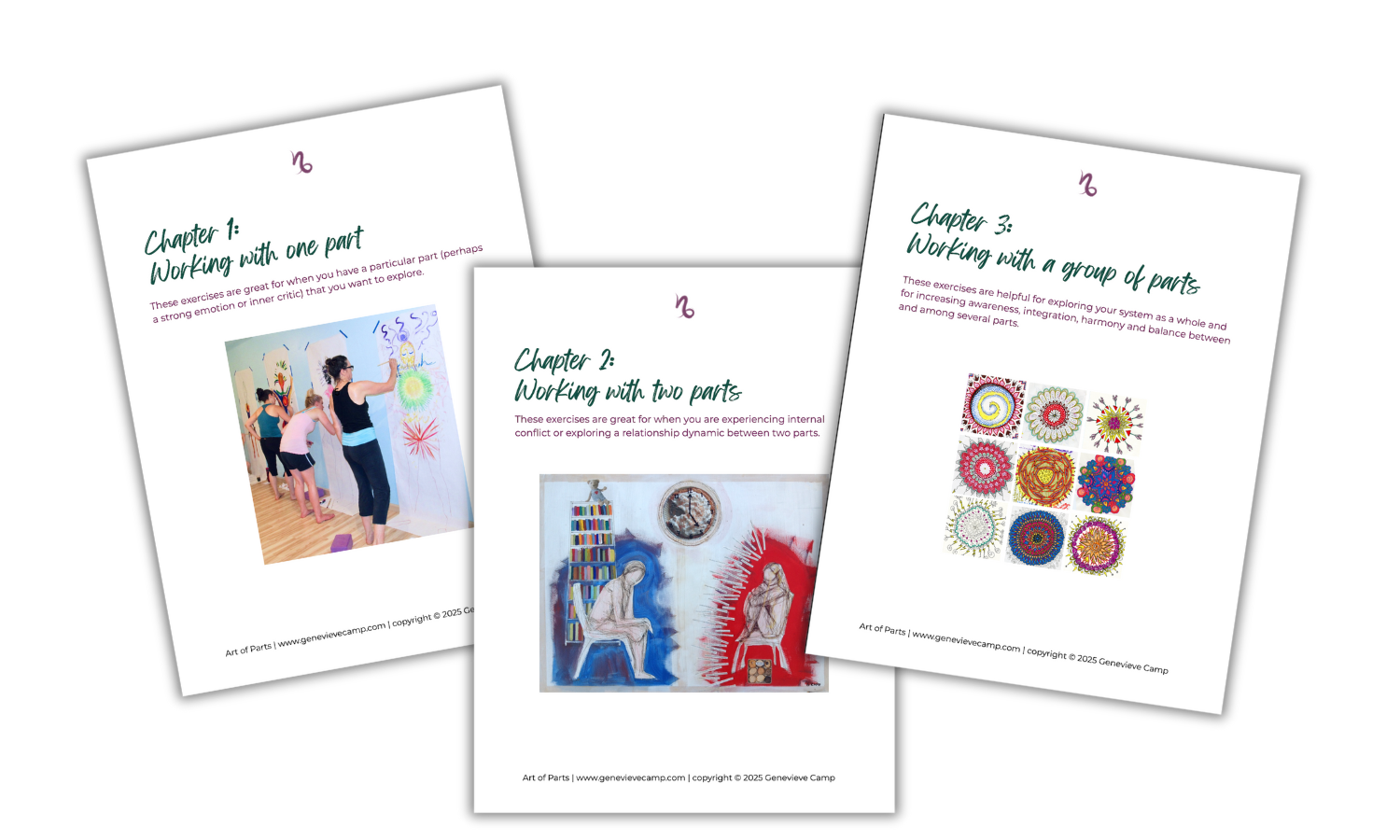
Exercises for any situation
Six art-based exercises organized into 3 sections for working with a single part, a pair of parts, or a group of parts. Each exercise can be returned to again and again.

Optional audio guidance
Each exercise has detailed written instructions but you also have the option to click on a link to an audio recording of me guiding you through the the process.

Printable templates
Optional printable templates make it easy for you to translate your thoughts, emotions, and body sensations into powerful visual representations.

Benefits of art-based IFS parts work include:
Enhanced neural plasticity and adaptive information processing from the bilateral stimulation (BLS) of using both hands. BLS is the mechanism used in EMDR therapy for resolving trauma.
Body-mind integration as a result of both bottom up (kinesthetic and somatic) and top down (cognitive insight and integration) processing.
A tangible record of parts you’ve explored that you can share with others, such as your IFS therapist or coach, or reference later for your own purposes.
Easier avenues for self-expression for parts that struggle to communicate with words—for example, very young or alexithymic parts may prefer communicating with color, shapes, and images.
A picture speaks a thousand words. Sometimes our internal landscapes and embodied emotional experiences are so complex and multidimensional that words alone fall short.
